
Microsoft Advertising uses the Universal Event Tracking (UET) tag to measure conversions from Microsoft (Bing) Ads. UET consent mode tells this tag whether the visitor allowed advertising storage. With the Premium add-on, Beautiful Cookie Banner sends this signal from your WordPress site, using the same consent settings as Google Consent Mode v2.
This page explains what the signal does, which calls the plugin makes, which cookies UET sets, and how to check that it works.
What UET consent mode does
UET consent mode has a single setting, ad_storage, with the value granted or denied. Microsoft describes the effect like this:
- denied: first-party cookies are neither read nor written for UET, and third-party cookies are not written. Third-party cookies may still be read, but only for fraud and spam purposes, not for advertising.
- granted: first- and third-party cookies may be read and written for UET.
If a site sends no default, UET treats ad_storage as granted. That is why the default call has to run before the UET tag.
Consent mode does not stop the UET tag from loading. It only changes how the tag uses cookies. If you want the tag to load only after consent, block it with service blocking or fire it with a consent trigger in Google Tag Manager.
Default and update calls
When the setting is on, the plugin adds the default call to the <head> of every page, before your tags. The value comes from your Google Consent Mode setting for ad_storage:
window.uetq = window.uetq || [];
window.uetq.push("consent", "default", {
  ad_storage: "denied"
});
When the visitor accepts a category that grants ad_storage, the banner sends the update straight away, without a page reload:
window.uetq.push("consent", "update", {
  ad_storage: "granted"
});
On every later page view, the default call is followed immediately by an update with the stored choice, so the UET tag already knows the current consent when it runs.
Cookies set by UET: _uetsid and _uetvid
UET uses two first-party cookies on your domain:
| Cookie | Purpose | Lifetime |
|---|---|---|
_uetsid | Session ID: connects the page views of one visit | about 1 day |
_uetvid | Visitor ID: recognises a returning visitor, so a conversion can be matched to an earlier ad click | about 13 months |
While ad_storage is denied, UET does not read or write these cookies. After the visitor grants ad_storage, they appear in your browser’s cookie list.
How to set it up in WordPress
- Install and activate the Premium add-on.
- Go to Settings > Cookie Consent Banner > Consent APIs > Google Consent Mode.
- Check Enable Google Consent mode and choose which banner categories grant
ad_storage(for example “marketing”). The Google Consent Mode v2 setup example explains this mapping. - Check Use ad_storage for Microsoft UET consent mode, too.
- Save, and clear the cache of your caching plugin.
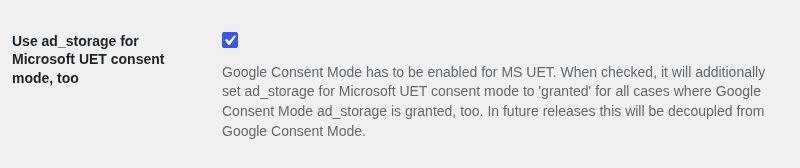
UET uses the same ad_storage value as Google Consent Mode, so Google Consent Mode has to be enabled for UET consent mode to work.
How to check that it works
Open your site in a private browser window, so you start without a stored choice. Then use one of these checks.
1. Browser console
Once the UET tag has loaded, run this in the console of your browser’s developer tools:
console.table(uetq.uetConfig.consent)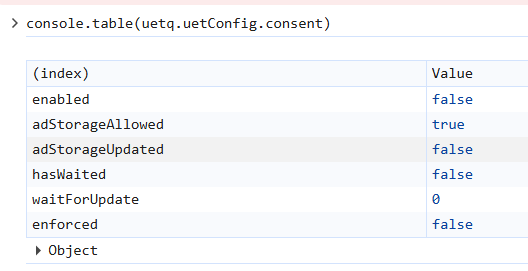
console.table(uetq.uetConfig.consent) outputBefore consent, ad_storage is denied. Accept the category that grants it in the banner and run the command again: it changes to granted.
2. Network tab
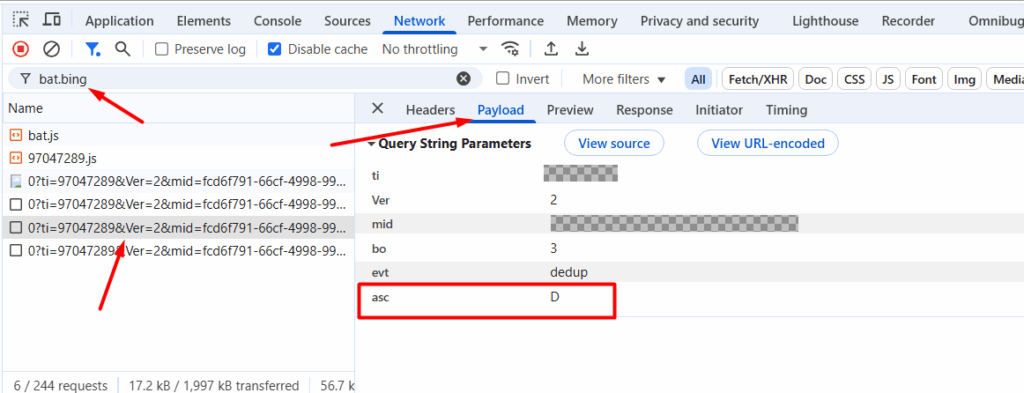
Open the Network tab, filter by bat.bing and open a request to bat.bing.com. In its parameters, asc shows the consent state:
asc=D: deniedasc=G: granted
3. Cookies
In the Application (Chrome) or Storage (Firefox) tab, look at the cookies of your domain. Before consent, a new visitor has no _uetsid and _uetvid cookies. After consent, both appear.
Related
- Google Consent Mode v2 for WordPress
- How to test and check Google Consent Mode v2
- Microsoft Clarity Consent API